
If you sell software, firmware, cloud tools, or connected parts for a medical device, FDA rules now reach you too. Since Section 524B took effect, device makers must show FDA how they track third-party code, patch flaws, manage support dates, and handle security issues before and after launch.
Here’s the short version:
- Many connected medical devices are now “cyber devices.”
- Third-party software and services are part of the review scope.
- SBOMs are a core document, not an extra.
- Premarket filings can fail early if cybersecurity records are missing.
- Postmarket work includes CVE review, patching, notices, and end-of-support planning.
- Hospitals and health systems should ask vendors for proof, not promises.
One stat makes the risk plain: 993 medical device vulnerabilities were reported in 2023. That means you can’t treat outside components like a side issue.
If I were reducing this article to the few points that matter most, I’d put it this way:
- I need to know whether the product is a cyber device
- I need an up-to-date SBOM for commercial, open-source, and off-the-shelf parts
- I need supplier terms for patches, support dates, disclosure, and change notices
- I need a clear process for monitoring CVEs, testing fixes, and warning customers
- I need these records tied back to the QMS and purchasing controls
| Area | What FDA expects |
|---|---|
| Scope | Connected devices with software and cybersecurity risk |
| Third-party vendors | OS, SDKs, libraries, firmware, cloud, remote access, crypto tools, open-source code |
| Premarket | Threat modeling, testing records, SBOM, update plan, vulnerability disclosure plan |
| Postmarket | CVE monitoring, advisories, patch delivery, compensating controls, support sunset planning |
| HDO action | Ask for SBOMs, patch terms, end-of-support dates, and incident processes |
This article is about one simple shift: FDA cybersecurity work no longer stops at the device manufacturer’s front door. If your product sits anywhere in the device stack, you may now be part of the compliance record.
Intro to Medical Device Cybersecurity (Premarket and Postmarket, FDA and EU)
sbb-itb-535baee
FDA Cybersecurity Framework and Premarket Submission Requirements
Section 524B applies to premarket submissions for cyber devices under 510(k), PMA, De Novo, PDP, HDE, and related supplement pathways.[1][2][12] If the cybersecurity documentation is incomplete, FDA can issue a Refuse-to-Accept decision before it even gets to the substance of the filing.[15] So the main issue is simple: the premarket record has to be complete and well supported.
What FDA Expects Before a Device Reaches the Market
Premarket evidence should show that security was built into the device from the start.[2][4] That means the submission should include threat modeling and security risk management records, along with system architecture diagrams, data flow diagrams, trust boundaries, assets, attack surfaces, and identified abuse cases.[2][9][13]
FDA also expects core controls to be tied to the threats they address.[2][13] That includes controls such as:
- access control
- encryption
- logging
- hardening
- secure updates
For third-party software and services, FDA expects those same controls to apply across inherited code and dependencies too.
Manufacturers also need to document verification and validation work. This includes secure coding, code review, static and dynamic testing, software composition analysis, penetration testing, and security sign-off.[2][4] The update plan should spell out how updates will be delivered and validated, how users will be notified, and how fast the company will respond to critical vulnerabilities.[1][2][9] The CVD plan should define intake, triage, and field advisories.[1][2]
Those controls also need to be traceable to each third-party component listed in the SBOM.
Software Bill of Materials and Third-Party Software Documentation
Section 524B requires manufacturers of cyber devices to submit a software bill of materials, or SBOM, that covers commercial, open-source, and off-the-shelf components.[1][2][7] FDA generally expects machine-readable SBOMs in SPDX or CycloneDX, with detail at the component level.[5][9]
For each component, the submission should identify the supplier, version, license, dependency relationships, support status, end-of-support dates, and known vulnerabilities such as CVEs, plus how those vulnerabilities were assessed and addressed.[2][10][5] The level of documentation can vary by component type.
| Third-Party Component Type | Examples | Key SBOM Fields | Additional FDA-Relevant Documentation |
|---|---|---|---|
| Commercial software | Proprietary database, imaging SDK | Name, version, vendor, license, dependencies | Vendor patch/update policy, support/EOS dates, vulnerability notification process |
| Open-source software | OpenSSL, Linux kernel module | Name, version, source, license, dependencies | Vulnerability monitoring approach, patch integration process, fork/patch policy |
| Off-the-shelf (COTS) | Windows, Android, embedded OS | Edition, version, vendor, config baseline | Hardening guides, update channels, EOS/EOL plan and migration roadmap |
HDOs can use SBOMs to find affected devices fast when a critical vulnerability appears. If a third-party component is disclosed as vulnerable, the SBOM helps teams trace the impact without wasting time.[5]
That inventory then serves as the starting point for monitoring and response after release.
Premarket vs. Postmarket Obligations
Premarket evidence and postmarket operations do different jobs.[1][2][8][11] Premarket work shows what was designed, tested, and documented before release. Postmarket work shows how the manufacturer monitors, updates, and responds once the device is in use.
| Obligation Area | Premarket (Design-Time) | Postmarket (Operational) |
|---|---|---|
| Risk management | Threat modeling, security risk analysis, control mapping | Continuous monitoring, new threat assessment, updated risk assessments |
| SBOM | Complete inventory with versions, licenses, EOS dates, known CVEs | Ongoing updates as components change or new vulnerabilities emerge |
| Vulnerability disclosure | CVD plan submitted with the application | Executing triage, remediation, and publishing advisories |
| Patching and updates | Documented update mechanism, timeframes, and validation process | Delivering patches, tracking deployment, issuing compensating controls |
| End-of-life planning | EOS/EOL plans for third-party components | Retiring devices, offering upgrades, communicating residual risks to HDOs |
These obligations set the baseline for supplier oversight and third-party vendor risk management and continued third-party risk management. They also feed straight into supplier governance and component risk management.
Third-Party Component Risk and Supplier Controls
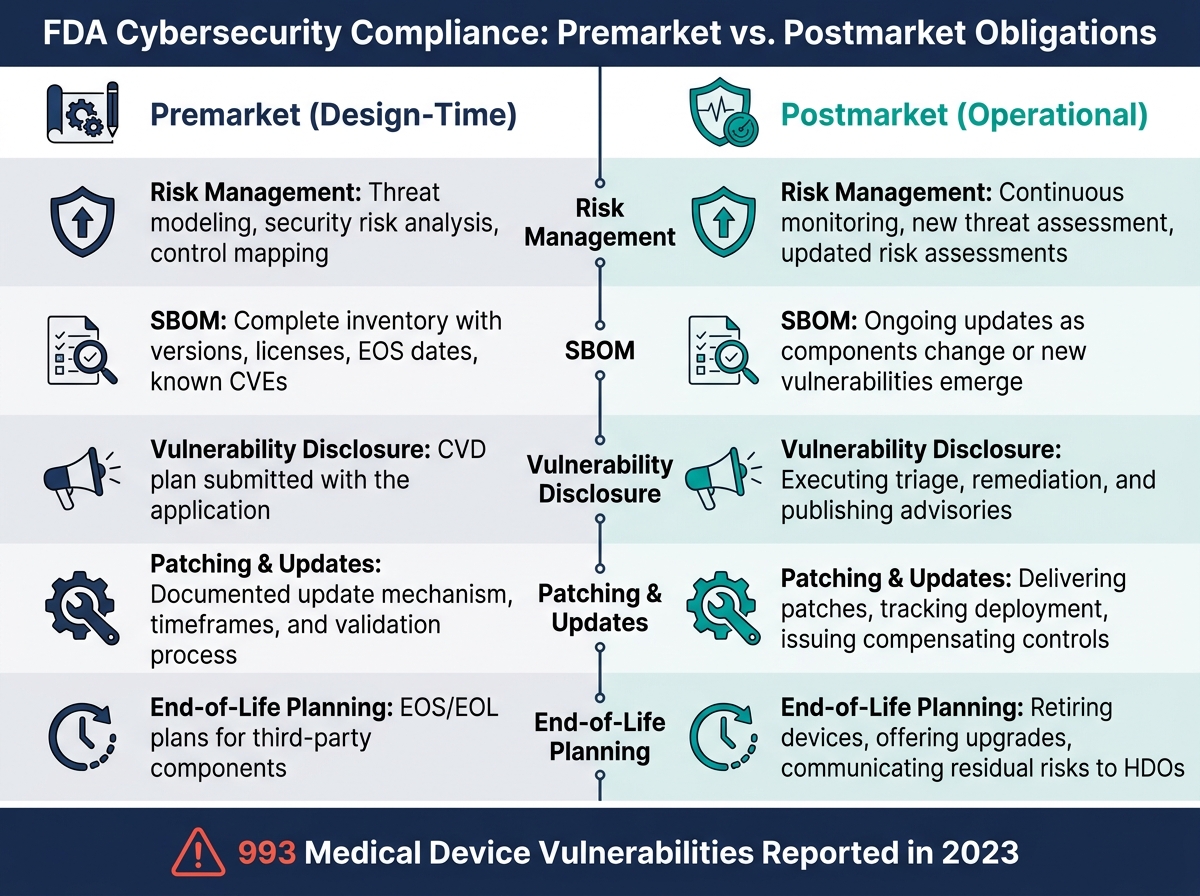
FDA Cybersecurity Compliance: Premarket vs. Postmarket Obligations for Medical Device Vendors
After submission, manufacturers still have work to do. They need to manage third-party risk across the full device lifecycle. Any SDK, library, OS, firmware module, or cloud service in the stack can introduce cybersecurity risk, so FDA expects manufacturers to keep watch on these dependencies over time. The SBOM is the working map here. Use it to tie each component to a supplier owner, support status, and update path.
How to Assess Commercial, Open-Source, and Off-the-Shelf Components
Review components based on vulnerability history, patch cadence, exploitability, and support status.[2][14][21] Check source integrity with signatures or checksums to cut supply chain security challenges and tampering risk.[14][18] For security-sensitive modules, verify whether the supplier uses secure development practices, runs code reviews, and performs penetration testing.[16][17]
End-of-support is one of the biggest trouble spots. Once a supplier stops maintaining a component, the device may no longer receive patches. That can weaken the manufacturer's Section 524B obligations for cyber devices.[6][10] FDA expects records of support status and end-of-support dates for third-party software components, plus a plan for what happens when support ends.[2][10]
That plan might include:
- Migration to a supported component
- Replacement of the affected module
- Temporary compensating controls, such as segmentation and stricter access[14][17][3]
HDO customers also need clear notice about end-of-support timelines and any residual risks.[4][6]
Supplier Governance Under FDA Quality System Expectations
That component inventory should feed directly into supplier qualification and contract terms. FDA purchasing controls require suppliers to meet stated cybersecurity requirements, not just functional ones.[14][20] Supplier qualification should review a vendor's vulnerability management process, secure development lifecycle, incident response capabilities, and willingness to take part in coordinated vulnerability disclosure.[14][19][20]
Keep an approved supplier list with documented evaluation records, such as questionnaires, audit results, penetration test reports, or certifications like ISO 27001 or SOC 2.[14][20] Contracts should include change notification clauses that require suppliers to alert manufacturers about major changes, including new versions, deprecated features, or architecture shifts that could affect device security.[14][19] Purchase specs should spell out cybersecurity requirements, including patch timelines, minimum support durations, logging capabilities, and SBOM transparency.[14][20]
For critical components, it also makes sense to negotiate terms like:
Each supplier change should connect to a documented risk review and an SBOM update before approval. Those controls support postmarket monitoring, patching, and vulnerability response.
Postmarket Monitoring, Vulnerability Response, and Lifecycle Management
Once a device is on the market, the cybersecurity work doesn't stop. It changes shape. FDA expects manufacturers to run a structured program that keeps watch for new threats, responds to vulnerabilities, and manages the device across its full lifecycle.[8][2] Premarket documents lay out the controls. Postmarket work shows those controls still hold up in the field.
That postmarket program builds on the premarket plan and uses the SBOM as a live inventory for triage and remediation. That's a big deal because third-party vulnerabilities keep piling up faster than many devices can be replaced.
The scale of the problem makes the need hard to ignore. A 2023 healthcare cybersecurity report found 993 medical device vulnerabilities in a single year.[23][22]
Continuous Monitoring and Coordinated Vulnerability Disclosure
Good monitoring starts with a simple question: Does this new CVE affect anything already deployed? To answer that, manufacturers should compare disclosed CVEs against the device SBOM. NVD and CISA's KEV catalog help flag which vulnerabilities affect components already in the field.[5][7][9]
HDOs should use that same SBOM to match advisories to active assets. And the signal doesn't always come from a database feed. Field service teams, support staff, and clinical teams may be the first to notice odd behavior or complaints. Those signals need a clear path to security and engineering teams, fast.[3][8]
Censinet RiskOps™ can help by centralizing vendor SBOMs, mapping vulnerabilities to deployed devices, and giving HDOs and vendors shared visibility into remediation work.[5][7] Once a vulnerability is confirmed, the next steps shouldn't be improvised. The response path should already be in place.
On the disclosure side, FDA treats coordinated vulnerability disclosure (CVD) as an expected part of the program under Section 524B of the FD&C Act.[25] A CVD program needs:
- A published policy
- An intake workflow
- An advisory format that states what is affected, the risk, and the fix[8][2]
Timing matters here. Advisories should go out early enough for HDOs to plan remediation without disrupting care. That may mean setting maintenance windows or applying compensating controls in critical departments first.[3][8][2]
Patching, Updates, and End-of-Support Decisions
Once a vulnerability is confirmed, risk-based prioritization drives the timeline. High exploitability and patient-safety impact call for faster action, especially for life-sustaining or critical-care devices.[8][16][13] CVSS scores and KEV listings are useful first filters, but they don't answer the whole question. What matters most is whether exploitation in a normal clinical setting could harm a patient or knock a device offline at the worst time.
Confirmed vulnerabilities should move through change control and regression testing, with faster handling for high-exploitability issues and devices used in critical care.[3][8][16] If a patch can't be deployed right away, FDA supports documented compensating controls as interim steps. That can include network segmentation, access restrictions, or tighter authentication on affected interfaces.[3][8][16] These measures buy time and reduce exposure until patching can happen.
If support has ended, the situation gets harder. When a supplier ends support, manufacturers must decide between migration, replacement, or documented residual-risk management until retirement.[24] Those choices should be documented and shared with HDO customers. The device SBOM and risk management records should be updated to match.[2][5][7][9][24]
Managing FDA Third-Party Cybersecurity Compliance Across HDOs and Vendor Networks
Postmarket monitoring is only one piece of the job. The harder part is keeping compliance steady across dozens - or even hundreds - of vendors and devices. Once monitoring and patching are in place, the next move is to scale those efforts across the full vendor network.
Build a Repeatable Compliance Workflow
It starts with a clean inventory. Identify every device that meets FDA’s cyber device definition, then map each one to its vendors and critical third-party components.[1][18]
Next, standardize how you collect and check supplier evidence. In practice, that means asking for:
- SBOMs
- Secure development lifecycle documentation
- Penetration test results
- Postmarket monitoring plans
These should be part of vendor onboarding and periodic reviews.[14][1][18] SBOMs also need updates whenever software changes, and they should link back to configuration records.
A centralized risk register helps keep all of this from turning into a mess. Use it to log findings, assign owners, set deadlines, and confirm closure.[16][8][18] Then connect that register to your quality management system so cybersecurity findings follow the same governance path as other quality issues. That’s how one-off reviews turn into a repeatable process.
Use Collaborative Risk Management to Scale Vendor Oversight
Large vendor networks need a shared system for assessments and remediation. Censinet RiskOps™ centralizes third-party assessments, benchmarks vendor posture, and tracks remediation across the supply chain.
Conclusion: Core Takeaways for Third-Party Vendor Compliance
A lasting FDA third-party cybersecurity program comes down to a few non-negotiables.
- Determine early whether a device qualifies as a cyber device under Section 524B of the FD&C Act. That decision drives every downstream requirement.[1]
- Document third-party components from the start and keep that documentation current.
- Match premarket evidence to what FDA expects: SBOMs, risk assessments, vulnerability management plans, and supplier control descriptions.[14][4][1][18]
- Enforce supplier controls through your QMS using 21 CFR 820.50 as the backbone.[18]
- Treat postmarket monitoring and vulnerability response as ongoing operational work, not a one-time checkbox.
The goal isn’t more work. It’s repeatable oversight.
FAQs
How do I know if my product is a cyber device?
Under Section 524B of the FD&C Act, a product counts as a cyber device if it:
- includes sponsor-validated software
- can connect to the internet or another network
- has tech features that could be open to cybersecurity threats
That can cover devices with wireless features or physical ports like USB, Bluetooth, or Ethernet, even if the device wasn’t built mainly for internet access.
If you’re still not sure whether your product fits, the FDA says you should contact the agency directly.
What should a third-party vendor include in an SBOM?
To meet FDA requirements, vendors should provide a machine-readable SBOM in a format such as CycloneDX or SPDX.
At a minimum, the SBOM should include the seven NTIA attributes:
- supplier
- component
- version
- unique identifiers
- dependency relationships
- author
- an ISO 8601 timestamp
It should also include lifecycle details, support status, end-of-support dates, known vulnerabilities, and all proprietary, third-party, and open-source software.
What happens if a supplier stops supporting a component?
If a supplier stops providing patches or support, the manufacturer still has to act to keep the device secure under the FDA’s Total Product Lifecycle framework.
That means the manufacturer needs to put compensating controls in place, plan a move to a different component, or formally explain why the remaining risk is acceptable.
The key point is simple: the manufacturer still owns inherited risk. So if a component can’t be patched anymore, they may need to isolate the device with network segmentation or securely decommission it.
