
If PHI is stored without encryption, one lost laptop or exposed backup can turn into a breach case fast. My takeaway is simple: use AES-256, match the mode to the storage type, keep keys separate in a KMS or HSM, and keep proof that encryption stayed on.
Here’s the article in plain English:
- AES-256 is a storage protection baseline for PHI at rest.
- AES-256-XTS fits full-disk and volume encryption on laptops, servers, and many device storage layers.
- AES-256-GCM fits files, objects, backups, and app-level or field-level data because it adds an integrity check.
- Under HIPAA, encryption is addressable, which means I still need a risk-based decision and written proof.
- Under HITECH, encrypted ePHI may avoid breach notice if the data is unreadable and the keys were not exposed.
- Encryption by itself is not enough. Key storage, rotation, access logs, restore testing, and exception tracking decide whether the control holds up in an audit or after an incident.
- The article also maps AES-256 use across endpoints, servers, databases, file shares, cloud storage, backups, removable media, and medical devices.
A few facts set the context:
- AES uses 128-bit blocks
- AES-256 uses a 256-bit key
- AES-256 runs 14 rounds
- NIST points to AES in storage encryption guidance, and HIPAA ties the discussion to 45 CFR § 164.312(a)(2)(iv)
If I had to cut the whole article down to one checklist, it would be this:
- Find every PHI repository
- Use XTS for disks and GCM for data objects
- Keep keys out of the systems holding the data
- Log key use and encryption status
- Test restores and review drift after changes
- Keep audit evidence ready
The core message is straightforward: AES-256 can lower breach exposure for healthcare data at rest, but only when the right mode, key controls, and audit trail are in place.
How AES-256 Works and Which Modes Fit Healthcare Storage
AES-256 Algorithm Basics for Security and IT Leaders
AES-256 uses a 256-bit key and 14 rounds to turn 128-bit blocks into ciphertext.[17][18][20] In each round, the algorithm applies substitution, row shifting, column mixing, and round-key addition. The goal is simple: even a tiny change in the plaintext or key should lead to a very different output. That’s the avalanche effect.
For healthcare teams, that matters because brute-force attacks against AES-256 are not practical for long-term PHI protection. But AES-256 alone doesn’t settle the whole storage question. The right mode depends on what you’re protecting: a disk, a file, or a database record.
AES-256-XTS vs. AES-256-GCM: When to Use Each
Storage devices and application data don’t need the same kind of protection.
AES-256-XTS, defined in NIST SP 800-38E, was built for block-based storage devices.[19][21] It encrypts data one sector at a time and does so without increasing sector size. XTS uses two 256-bit keys plus a tweak value, usually the sector number, so identical data stored in different places produces different ciphertext. Its job is confidentiality only.[14][16]
AES-256-GCM, defined in NIST SP 800-38D, is an authenticated encryption mode. It pairs counter-mode encryption for confidentiality with an authentication tag for integrity and authenticity.[8][9][15] If someone changes the ciphertext, tag verification fails. That makes GCM a better fit when records, files, or objects need to be encrypted and checked on their own.
Here’s the practical split:
| Use Case | Recommended Mode | Key Benefit |
|---|---|---|
| Full-disk encryption on laptops and servers | AES-256-XTS (SP 800-38E) | Sector-level confidentiality, no size overhead |
| Volume encryption on virtual machines and servers | AES-256-XTS (SP 800-38E) | Efficient random-access storage protection |
| File, object, and database encryption | AES-256-GCM (SP 800-38D) | Confidentiality + integrity verification |
| Application-level PHI encryption | AES-256-GCM (SP 800-38D) | Detects tampering and supports auditability |
NIST Standards and Key Management Basics
Once you pick a mode, key management becomes the next big control.
Three NIST publications set the base for AES-256 use in healthcare. FIPS 197 defines the AES algorithm itself.[1][2] The SP 800-38 series covers approved modes, including SP 800-38E for XTS and SP 800-38D for GCM.[8][14][19] NIST SP 800-57 Part 1 covers key management, including how long keys should stay in use, when to rotate them, and who should control them.[11][12][13]
On the key side, three controls matter most:
- Separate duties so the person who generates a key is not the same person who uses or approves it.
- Store PHI keys in a KMS or HSM and access them through controlled APIs.[12]
- Set a cryptoperiod for each key, then rotate keys when that period ends or after a suspected compromise.
For healthcare organizations, encrypting PHI is only part of the job. The keys behind AES-256 need the same level of care: documented cryptoperiods, access logs, rotation schedules, and backup procedures that keep key material away from unauthorized users.
sbb-itb-535baee
Regulatory Requirements and Risk Management for PHI Encryption
HIPAA, HITECH, and Breach Safe Harbor in Practice
Once AES-256 is in place, the next step is simple: can you show it meets HIPAA and audit demands?
The HIPAA Security Rule at 45 CFR § 164.312(a)(2)(iv) lists encryption and decryption of ePHI as an addressable implementation specification. That doesn't mean you can ignore it. Covered entities and business associates still have to assess risk, decide whether encryption is reasonable and appropriate, and then either put it in place or document a justified alternative with compensating controls.[26][28][29]
In day-to-day enforcement, unencrypted devices with PHI have often been treated by regulators and courts as reportable breaches. That has led to major penalties and settlements.[4][27][24] On the other hand, if ePHI is encrypted with NIST-approved methods and the keys are kept separate, a lost or accessed device may qualify for HITECH safe harbor and avoid breach notification.[25][7][10]
That sounds straightforward on paper. But during an investigation, you need proof. Your incident response process should gather technical evidence showing that AES-256 was active at or near the time of the event. That includes system logs, encryption configuration outputs, and status reports, plus a clear timeline showing that only encrypted data, without keys, was exposed.[22][3][23]
HITRUST, NIST, and Internal Control Documentation
Passing a HIPAA risk analysis isn't enough by itself. Auditors also want control evidence they can review. HITRUST CSF and NIST references help show that encryption decisions follow a set standard, are written down, and can be checked later. Each encryption control should tie back to internal policy and written standards.
In an investigation, a control only counts if you can prove it. Logs, configuration exports, and timestamps do that work. For each PHI-bearing system, the documentation package should cover the following:
| Documentation Element | What to Capture |
|---|---|
| System scope | Which systems, databases, devices, and cloud services hold PHI |
| Encryption mode and algorithm | AES-256, with the relevant NIST reference |
| Key management policy | Cryptoperiod, rotation schedule, access controls, and key custody evidence |
| Exceptions and compensating controls | Any system not yet encrypted, with documented rationale and timeline |
| Audit evidence | Logs, configuration exports, scan results confirming encryption status |
| Breach safe harbor alignment | Evidence that encryption and key protection meet HHS/NIST requirements |
This kind of documentation helps boards, audit committees, and regulators see that encryption is a managed control, not just a box someone checked once and never looked at again.
Using Censinet RiskOps to Govern Encryption-Related Risk
At scale, encryption governance needs a single place to track scope, exceptions, and remediation. Censinet RiskOps™ can centralize encryption-related risk tracking, ownership, and remediation across PHI systems, third parties, and backups.
How to Implement AES-256 Across Healthcare Storage Types
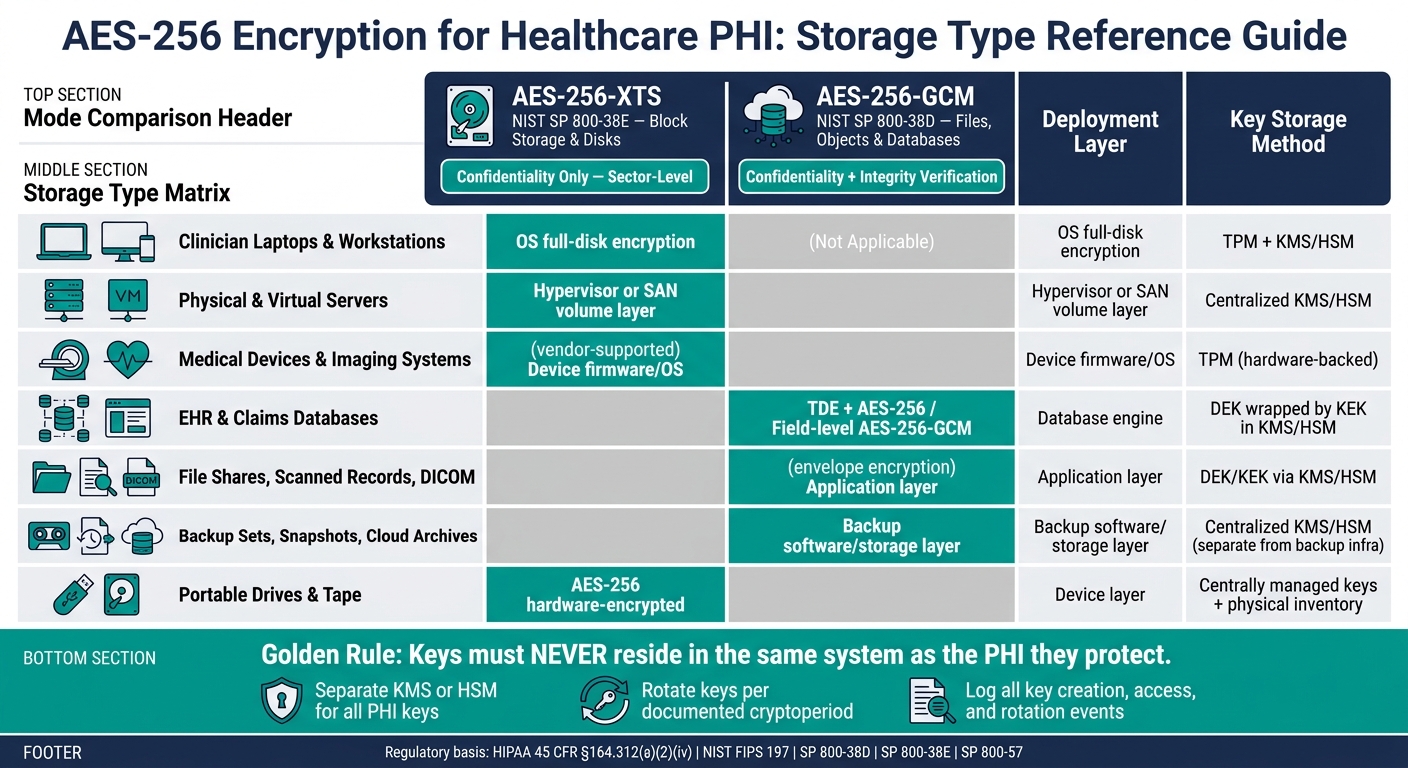
AES-256 Encryption Modes for Healthcare PHI Storage: XTS vs GCM by Use Case
Apply AES-256 based on the storage type. Use XTS for block storage and GCM for files, objects, and databases. The idea is simple: match the mode to the storage layer, then use it the same way across endpoints, servers, databases, backups, and media.
Full-Disk and Volume Encryption for Endpoints, Servers, and Medical Devices
For clinician laptops and workstations, AES-256-XTS is usually set up with OS-native tools like BitLocker with XTS-AES 256 on Windows or with FIPS 140-2/140-3 validated third-party products. If a device can leave the facility and may contain PHI, pre-boot authentication matters. That can mean a PIN plus a smart card, PIV badge, token, or biometric. Keys should live in the device TPM and tie into a KMS or HSM.
Physical and virtual servers that run EHR, billing, or imaging workloads should use AES-256-XTS at the hypervisor or storage layer, with centralized key management and AD/LDAP-based access control. For medical devices and imaging systems like PACS workstations, modalities, and bedside monitoring devices, vendor support is often the main constraint. So encryption needs to be explicitly turned on and checked against FIPS requirements for PHI workflows.
Re-check encryption after OS patches, firmware upgrades, storage replacement, or redeployment. Settings can drift after hardware changes. It’s much better to catch that in a routine compliance review than during an OCR or state AG investigation.[31][33]
Block storage and application data call for different controls, so the next step is repository encryption.
Database, File, Object, and Application-Level Encryption for PHI Repositories
For EHR, claims, and clinical databases, Transparent Data Encryption (TDE) with AES-256 at the database or tablespace level is the right place to start. TDE protects data at rest and backups from disk theft or unauthorized snapshot access, and it does that without major application changes. For highly sensitive data like Social Security numbers, behavioral health notes, or financial account data, field-level AES-256-GCM adds integrity checks and tighter access scoping at the application layer.[32]
For file shares, scanned records, object storage, DICOM imaging repositories, and exports, use envelope encryption. Files are encrypted with short-lived Data Encryption Keys (DEKs) using AES-256-GCM. Each DEK is then wrapped by a longer-lived Key Encryption Key (KEK) stored in a KMS or HSM. In plain terms, the KMS manages keys, not PHI. This setup supports per-patient, per-document, or per-study key scoping, which limits the blast radius if one key is compromised.
Backups need the same level of protection, and that protection has to start when the data is written.
Backups, Archives, Removable Media, and Key Management Operations
Encrypt backups at write time. Backup sets, snapshots, and cloud archives should use AES-256-GCM so PHI is never left briefly exposed during the backup process. Keys for backup encryption belong in a centralized KMS or HSM - not in backup software config files or scripts, where a compromised backup server could expose them.[30][34]
For portable drives and tape used in offline or air-gapped disaster recovery, use hardware-encrypted drives or FIPS-certified encrypted USB media with centrally managed keys and physical inventory controls. When retiring tape, decommissioning archives, or repurposing disks that held PHI, destroy or revoke the keys so the data can’t be recovered. Key destruction should be handled as a formal record with approvals, timestamps, and asset disposition tickets.[34][35]
The table below maps each storage surface to the recommended AES-256 mode, deployment layer, key storage approach, and key regulatory considerations:
| Storage Type | AES-256 Mode | Deployment Layer | Key Storage | Regulatory Notes |
|---|---|---|---|---|
| Clinician laptops / workstations | AES-256-XTS | OS full-disk encryption | TPM + KMS/HSM integration | Reduces breach exposure for lost devices |
| Physical / virtual servers | AES-256-XTS | Hypervisor or SAN volume layer | Centralized KMS/HSM | Protects EHR, billing, imaging workloads; use FIPS-validated cryptographic modules |
| Medical devices / imaging systems | AES-256-XTS (vendor-supported) | Device firmware / OS | TPM (hardware-backed) | Must be explicitly enabled; validate FIPS compliance per device |
| EHR / claims databases | TDE with AES-256 + field-level AES-256-GCM | Database engine | DEK wrapped by KEK in KMS/HSM | TDE for broad protection; field-level for SSNs, behavioral health data [32] |
| File shares / scanned records / DICOM | AES-256-GCM (envelope encryption) | Application layer | DEK/KEK via KMS/HSM | Per-object or per-study key scoping limits compromise scope |
| Backup sets / snapshots / cloud archives | AES-256-GCM | Backup software / storage layer | Centralized KMS/HSM (separate from backup infra) | Encrypt at creation; keys never embedded in backup configs [30][34] |
| Portable drives / tape | AES-256 (hardware-encrypted drives preferred) | Device layer | Centrally managed keys; physical inventory controls | Destroy or revoke keys at decommission; maintain formal key-destruction records [34][35] |
Once encryption is in place, it has to remain enabled, keys have to stay separate, and any exceptions have to be easy to spot.
Operating, Auditing, and Improving AES-256 Controls Over Time
Policies, Baselines, and Change Control for Encryption at Rest
Once AES-256 is in place, governance keeps it from slipping. Encryption coverage can drift without much noise. A server gets reimaged. A cloud bucket is reconfigured. A vendor pushes an update that changes storage defaults. Then a PHI repository ends up running without the protection it had last quarter.
The fix is simple in concept: keep a version-controlled cryptography standard that defines the required settings and flags anything that falls out of line.
That standard should set AES-256 as the minimum for all PHI at rest, list the approved modes, and block weaker options. For example:
- XTS for disks and volumes
- GCM for files, objects, and application data
- No AES-128, 3DES, or proprietary vendor crypto
It should also lay out a formal exception process: who can approve a deviation, which compensating controls must be in place, and how long an exception can remain open before it must be closed or pushed up for review. [42][43][33]
Each major asset class - endpoints, servers, databases, cloud storage, backups, and removable media - should have its own configuration baseline spelling out the minimum accepted setup. Keep those baselines in a configuration management repository and enforce them with tools like Ansible, Puppet, or SCCM. Review them twice a year as vendor features and NIST guidance shift. Any change touching storage, databases, hypervisors, or KMS/HSM integrations should go through a security review before release. After the change, verify that AES-256 is still active and that the approved mode didn't change. [36][38]
Monitoring Key Access, Encryption Status, and Control Drift
Written baselines don't mean much unless changes and exceptions are tracked. Logging is what makes encryption governance auditable. HHS audit materials ask whether only authorized personnel can create or modify keys. That puts separation of duties and least-privilege controls for KMS/HSM administrators squarely in audit scope, not just on a best-practice wish list. [37]
At a minimum, teams should log and review three groups of events:
- Key management events from the KMS or HSM, such as creation, activation, usage for encrypt/decrypt, rotation, export, administrative changes, and failed access attempts
- Encryption state and job results, including per-volume and per-database encryption status, scheduled job outcomes, backup encryption results, and errors that leave data briefly unprotected
- Configuration drift, such as changes to OS disk encryption settings, cloud bucket policies, database encryption flags, and IAM or security group changes that affect key access [36][37][41]
When these logs feed into a SIEM, teams can build dashboards that show the share of PHI systems encrypted with AES-256, key rotation compliance, and open baseline deviations. High-severity alerts - like disabled encryption or unsanctioned key export - should trigger an immediate security review under a documented runbook.
One detail that often gets missed is restore testing. Encryption can't get in the way of recovery. NIST SP 800-111 and HHS-focused guidance both stress recovery and key protection as core parts of storage encryption operations. That means periodic restore drills, with checks for both data integrity and key availability, belong in the audit scope. [39][40][5]
Conclusion: Where Healthcare Leaders Should Start
After enforcement and monitoring, the next piece is executive reporting. AES-256 is a proven, practical baseline for protecting PHI at rest. But encryption only supports HIPAA/HITECH breach safe harbor if it stays in force over time. HHS guidance is direct: encrypted PHI that meets NIST standards can fall within safe harbor, but that protection disappears the moment encryption lapses or keys are mishandled. [5][6]
That is why governance, risk documentation, and measuring what matters for cybersecurity and continuous monitoring aren't side items in an encryption program. They're what make the program defensible when an incident hits or an auditor starts asking questions.
For leaders who are just getting started with standardization, the priority order is straightforward: inventory PHI repositories, manage portfolio risk by enforcing AES-256 baselines, centralize key management logging, and build regular reporting that gives executives a clear view of coverage, exceptions, and trend data. Standardize backup encryption and keep keys in a KMS or HSM. Each step cuts exposure and builds the audit trail needed to show that controls stayed active across the full review period. [42][43]
FAQs
When should I use XTS instead of GCM?
Use AES-256-XTS for full-disk or volume encryption on laptops, desktops, workstations, and on-premises file servers. It’s built to protect data at rest if hardware is lost or stolen.
Use AES-GCM for files, object storage, cloud backups, and sensitive database fields. It protects confidentiality and also checks data integrity with authentication tags, which XTS does not provide.
Does AES-256 encryption satisfy HIPAA by itself?
No. Under the HIPAA Security Rule, encryption is an addressable safeguard, not a mandatory requirement. Organizations need to decide whether it makes sense for their setup, put it in place if it does, or document and justify another option that reaches the same goal.
The HIPAA Breach Notification Rule safe harbor is conditional too. It calls for an approved algorithm like AES-256, along with strong key management. That includes storing keys separately and using FIPS-validated cryptographic modules.
What happens if encryption keys are exposed?
If encryption keys are exposed, encrypted data can be read and used by people who shouldn't have access. Once that happens, the data is no longer secure.
Under HIPAA and HITECH, safe harbor usually depends on two things: the data stays encrypted, and the keys stay protected. If the keys are lost or compromised, any related loss or theft of PHI may trigger breach notification requirements and create major compliance and liability risks.
